The Ejection Site
F/A-18 Martin-Baker seat
 The McDonnell-Douglas F/A-18 is
an example of military procurement rivalry. MCD is known in the egress industry
for the manufacture of the ESCAPAC, MINIPAC, and ACES series of ejection seats,
all of which enjoy a good reputation for success. The U.S. Navy has used the
ESCAPAC seats for some time in many different aircraft, but when selection
was announced for the F/A-18, it was Martin-Baker Aircraft who won
the competition. The Martin-Baker Mk. 10 has a typical late model Martin-Baker
structure with a Main Beam Assembly (MBA) supporting the
seat bucket, shoulder harness restraint, and the headrest parachute pack. Other
sub-assemblys attached to the MBA are the drogue deployment unit and the
parachute deployment rocket. The MBA attatches the seat to the aircraft
via latch assemblies on the top and bottom of the catapult and guide rail
assembly. The seat is equipped with the standard leg restraint system
which consists of a set of garters the pilot wears on his legs, and a leg
restraint line set which is routed from the floor of the cockpit through the
front of the seat bucket, into the garters and then back to the seat bucket.
This arrangment causes the restraint lines to hold the legs back against
the bucket where they land as the seat rises up the guide rails.
A set of break rings snaps when the seat has traveled up the rails far enough
to provide sufficient force. Friction snubbers keep them there until seat man
separation when the timed release mechanism releases the lap belt locking lugs
and other seat/man attach points.
The McDonnell-Douglas F/A-18 is
an example of military procurement rivalry. MCD is known in the egress industry
for the manufacture of the ESCAPAC, MINIPAC, and ACES series of ejection seats,
all of which enjoy a good reputation for success. The U.S. Navy has used the
ESCAPAC seats for some time in many different aircraft, but when selection
was announced for the F/A-18, it was Martin-Baker Aircraft who won
the competition. The Martin-Baker Mk. 10 has a typical late model Martin-Baker
structure with a Main Beam Assembly (MBA) supporting the
seat bucket, shoulder harness restraint, and the headrest parachute pack. Other
sub-assemblys attached to the MBA are the drogue deployment unit and the
parachute deployment rocket. The MBA attatches the seat to the aircraft
via latch assemblies on the top and bottom of the catapult and guide rail
assembly. The seat is equipped with the standard leg restraint system
which consists of a set of garters the pilot wears on his legs, and a leg
restraint line set which is routed from the floor of the cockpit through the
front of the seat bucket, into the garters and then back to the seat bucket.
This arrangment causes the restraint lines to hold the legs back against
the bucket where they land as the seat rises up the guide rails.
A set of break rings snaps when the seat has traveled up the rails far enough
to provide sufficient force. Friction snubbers keep them there until seat man
separation when the timed release mechanism releases the lap belt locking lugs
and other seat/man attach points.
Since I have yet to get releasable photos of the Mk. 10L used in the F/A-18 as the
SJU-5/6, I refer you to the photos of a Mk. 10A on this page as the
mechanisms are very similar. The seat pan and headrest shapes are somewhat different, as
is the paint coloration, but some of the details are clear. I hope to have photos of the SJU-5
soon.
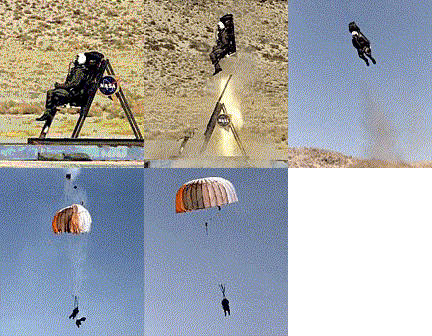
The above Gif is a series of still photos of a NASA test of the F/A-18 seat in
the 0-0 mode to qualify a change in the parachute canopy from the standard
U.S. Navy type to the same one used in the ACES II ejection seat. Any change
of seat equipment that could effect the functionality of the seat is tested
to make sure the seat still is reliable. This series of photos clearly
illustrates a typical launch sequence. The Center of gravity was slightly
low as you can see by the seat tipping forward just after the seat leaves the
rails. The seat rotates slightly, also an indication of an imperfect seat CG
(note this is extremely normal in all seat employment- seats are designed to
handle occupants from a small pilot up to quite a large pilot, and there is
virtually no way to make sure the CG of the seat man package is exactly on the
centerline of the line of thrust of the rocket. A small deviation is normal,
but if the deviation was too great the seat would tumble and possibly injure
the occupant, or disrupt a clean parachute deployment or seat separation).
In this case, the deviation was within normal limits and the seat functioned
as designed.
1 / 6
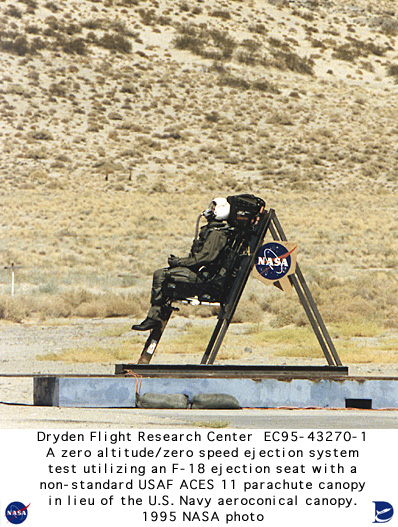
Seat prior to launch
2 / 6
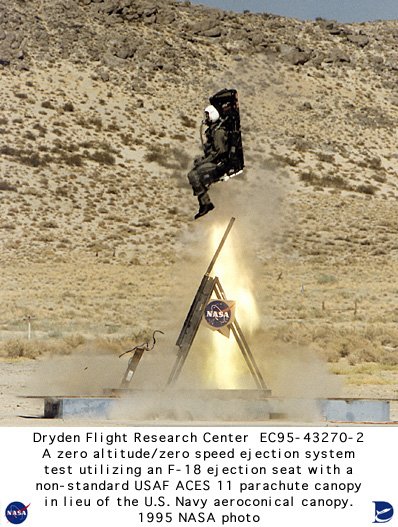
Seat just after clearing the pad"
3 / 6
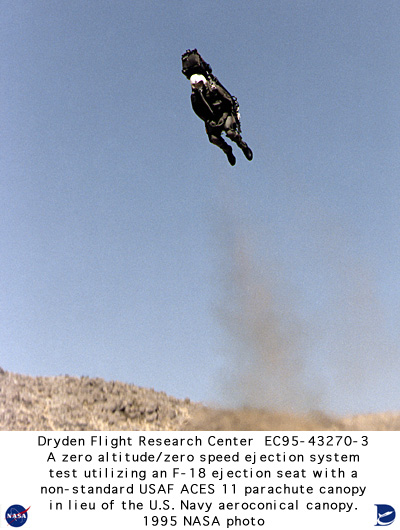
Seat at rocket burnout
4 / 6
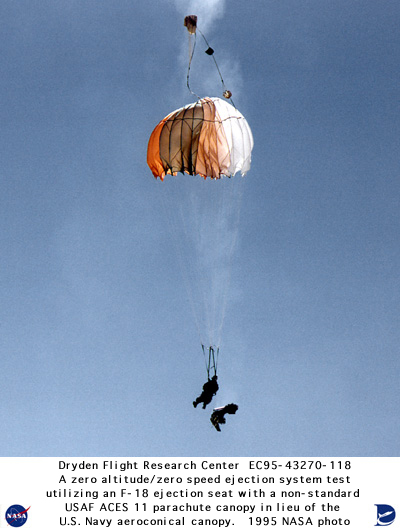
Seat separation
5 / 6
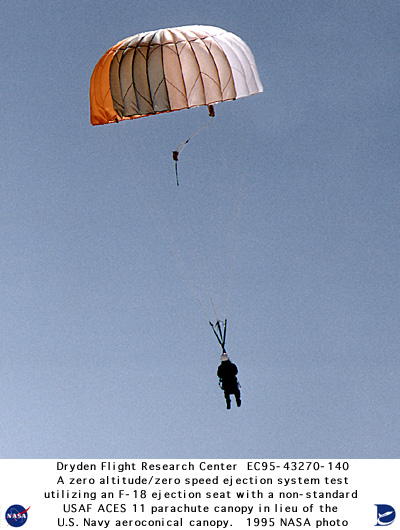
Parachute fully deployed
❮
❯
Pictures by NASA
Note: Many of the F/A-18 aircraft in service are equipped with the Mk. 14 NACES seat under the
SJU-17 designation. Hopefully photos of that version will become available soon.